
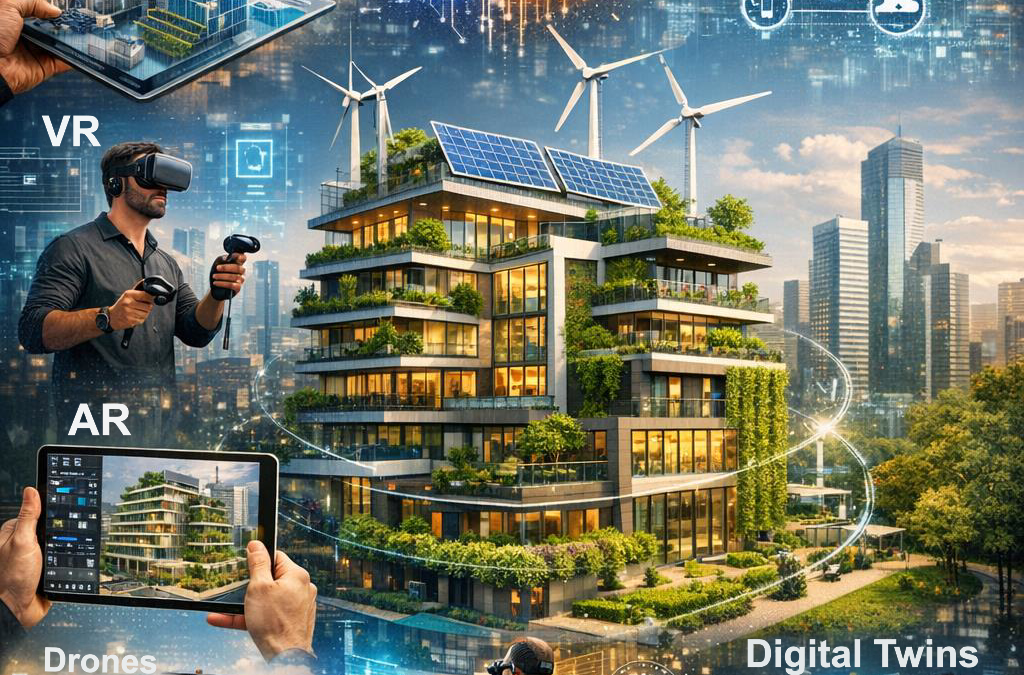
Digitalization refers to the use of digital tools to optimize different processes within architecture, engineering, and construction. These tools help improve communication and coordination among work teams, reduce errors and waste, and increase efficiency and productivity. For example, digital project management systems enable more accurate planning and organization, while 3D modelling and virtual reality make it possible to anticipate and refine designs before construction begins.
Digital solutions help increase safety in construction environments and strengthen quality control and regulatory compliance procedures. Overall, the integration of these technologies in the construction sector helps reduce costs, optimize resources, decrease waste, improve project outcomes, and enhance the industry’s global competitiveness. Digitalization has emerged as a key element in driving change within the construction sector. The role of the new digital technologies is globally recognized as an accelerator of economic and social development, as well as environmental protection.
The construction sector is characterized by the generation of large amounts of waste, high demand for resources and raw materials, and significant energy consumption. The incorporation of digital processes and environments into construction activities can greatly improve this negative aspect, both from a business perspective and in terms of sustainability. Digital technologies can help promote a more sustainable construction model that is better able to adapt to the effects of climate change, in line with the main objective of Directive 2024/1275 on the energy performance of buildings.
From BIM Universe to AI: Key digital tools that are reinventing the green construction sector
Digitalization in the construction sector has become an essential element, with applications across all phases of a project´s life cycle (from planning and design to execution, maintenance, demolition, as well as material extraction and transportation). In January 2025, the European Commission presented the Competitiveness Compass, a roadmap aimed at reducing innovation gaps, strengthening industrial resilience, and ensuring access to clean and affordable energy. The digitalization of the construction sector is essential to achieving high-quality, sustainable, and energy-efficient buildings. It also represents an opportunity to innovate and decarbonize the entire value chain. Among the technologies driving this transformation are:
Building Information Modelling (BIM) is already a standard in many public procurement processes because it improves project coordination and planning, reducing errors. BIM enables real-time adoption of multidisciplinary models, advanced risk simulations and alternatives scenarios, and full visibility throughout the entire building life cycle. It facilitates comprehensives building management from design to demolition.
Digital Twins (DT) is a real-time digital representation of the building. The information is obtained through sensors installed on-site, which continuously monitor changes in the building and its surroundings. These sensors update the BIM model with the most recent data and measurements. With DT, companies can estimate resources needs more proactively, reduce unnecessary travel, and optimize waste management. In this sense, DT enables more efficient, prediction-based planning. DT also allows for periodic monitoring of building to quickly identify when any intervention is required.
3D printing y 3D scanning facilitate prefabrication, quality control and waste reduction. The laser scanner creates a point-cloud image that accurately reproduces the scanned elements. BIM systems and Computer-Aided Design (CAD) allow the creation of 2D drawing or 3D models based on the acquired data. 3D printing enables new, tailor-made shapes using new materials or traditional ones adapted to the printing system. This technology allows construction professionals to carry out design processes efficiently and rigorously.
Virtual Reality (VR) is a technology that allows the user to enter a fully computer-generated artificial environment. Augmented Reality (AR) is an emerging technology with broad potential. It combines digital information with physical information in real time. This combination is achieved through different technological devices, such as phones or tablets, creating an enhanced reality with data from both the physical and virtual worlds. It is commonly used in training for safety purposes and in immersive design visualizations.
Internet of Things (IoT) refers to systems and devices that receive and transfer data through wireless networks with minimal human intervention, thanks to the integration of computing components into all types of objects. IoT systems operate by continuously sending, receiving, and analyzing data in a feedback loop that speeds up their optimization. These smart sensors collect environmental and operational data that feed predictive analytics systems, enabling more proactive resource management.
In recent years, drones have become an indispensable tool for real-time construction monitoring. Drones make it possible to detect failures, deviations in the work, and safety issues. This constant data collection supports decision-making based on up-to-date information and helps prevent costly delays and unnecessary use of resources and materials.
Construction industry digitalisation is essential for achieving a sector that is not only competitive, but also greener, smarter, and more resilient. It is crucial that digitalization supports the entire life cycle of building, in line with the objectives of circular construction policies and their role in meeting the EU´s renovation goals.
Digital advances driving sustainability in European construction.
Recent advances in sustainable construction demonstrate how these technologies are reshaping the built environment and enabling greener, more efficient buildings. Globally, smart construction sites now rely on IoT sensors, drone-based LiDAR and real-time digital twins to optimise resources and reduce errors, significantly improving sustainability performance. Large-scale building projects have become benchmarks for sustainable design thanks to BIM and DT, which support energy modelling, scenario testing, and long-term adaptability.
In Spain, innovation initiatives such asCOSOSFU integrate BIM, DT, 3D printing and AI to reduce environmental impact and optimise energy efficiency in new construction systems. While Spanish contractors increasingly use drones for geospatial capture, DT integration, and real-time quality control, improving safety and sustainability across sites nationwide.
Similar progress is visible in Portugal, where universities and industry partners are developing BIM-based workflows and 3D-printed sustainable housing prototypes under initiatives like theRein4Concrete project, which uses digital ecosystems to reduce material consumption and construction emissions.
Greece is advancing digital sustainability through digital-twin pilots for smarts buildings and urban environments, such as the case study in Larissawhere IOT sensors and BIM integration enable real-time energy optimization and predictive maintenance in a multiapartment building.
Germany is also emerging as a leader in sustainable digital construction, with large-scale 3D printing research project, such as the AM2PM initiative, leveraging robotics and advanced materials to cut concrete use and CO2 emissions by up to 50% in multistorey buildings, while nationwide urban DT programmes in cities like Hamburg, Munich, Leipzig and Stuttgart support climate-adapted planning and energy- efficient redesign of mobility and infrastructure systems.
Together, these European examples show how digitalisation is accelerating the transition towards a more sustainable, circular, and resilient construction sector across the continent. In line with these objectives, the Green Circle: Microcredentials in the Construction Sector project promotes lifelong learning among sector stakeholders in green digital skills. Through scalable micro-courses with increasing levels of complexity and valid across the EU.