
Construction has long been one of the key pillars of development, supporting infrastructure, housing, public spaces and economic activity. However, in the current context of sustainable development, where progress can no longer be understood solely as economic growth but must also integrate environmental, social and governance dimensions, the sector faces unprecedented challenges: climate change, resource scarcity, increasingly demanding regulations, higher energy-efficiency requirements, and the urgent need to reduce its environmental footprint.
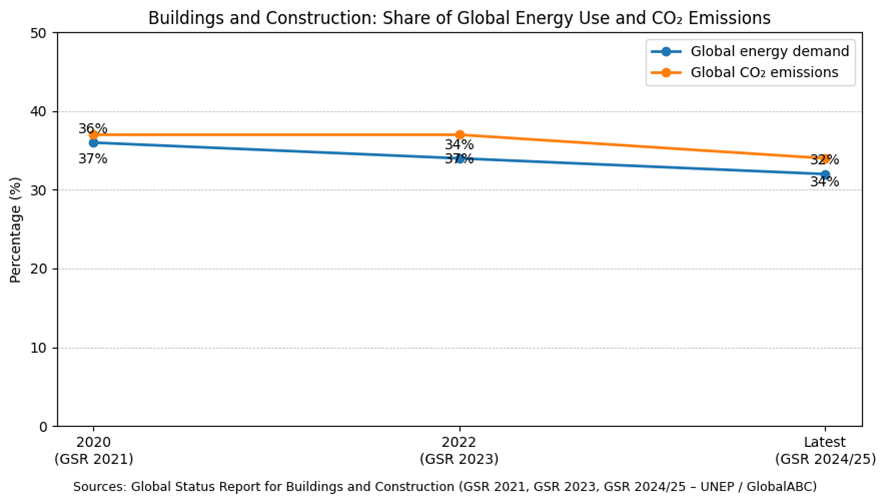
This challenge is particularly critical given that the buildings and construction sector remains one of the main contributors to the global climate crisis. According to the Global Status Report for Buildings and Construction, buildings and construction accounted for around 34% of global energy demand and approximately 32% of energy- and process-related CO₂ emissions in 2024-2025.
In this context, sustainability in construction must be understood as a business imperative, not as an additional burden. It is a prerequisite for the long-term viability of the sector. However, this transition can only succeed if human capital is equipped with the right skills and competencies, and this is where one of today’s greatest challenges emerges.
Microcredentials and Lifelong Learning as Drivers of the Transition
Flexible education based on microcredentials, continuous upskilling and specialised training is increasingly becoming a key driver of transformation. Microcredentials enable professionals across the construction value chain to acquire targeted sustainability-related competencies, such as:
- technicians with expertise in environmental efficiency, life-cycle assessment and sustainable materials.
- managers capable of integrating climate and circularity criteria into budgeting, planning and operations.
- designers, engineers and architects prepared to think in terms of resilience, durability and adaptability.
This approach is aligned with the Council Recommendation of the European Union on microcredentials, which highlights their role in responding flexibly to evolving labour market needs and supporting the green transition.
Unlike long and inflexible traditional learning pathways, microcredentials allow for modular, focused and verifiable learning, helping sustainability move from an aspirational value to a distributed organisational capability, embedded in everyday professional practice.
Net-Zero and Resilience: Technology Matters, but People Matter More
Another central element of this transformation is the growing adoption of Net-Zero solutions for buildings and infrastructure, designed to neutralise net emissions. In Europe, this ambition is reinforced by the revision of the Energy Performance of Buildings Directive, which introduces zero-emission buildings as a new standard.
Yet, beyond technology, the success of Net-Zero buildings largely depends on the capabilities of the people who design, build, supervise and operate them. Achieving these objectives requires mastering complex competencies such as life-cycle assessment of products and buildings, intelligent energy management, and the selection of low-carbon or carbon-sequestering materials.
This is compounded by the need to design for uncertainty. Climate change is intensifying extreme events that directly affect the durability and functionality of infrastructure. In response, it is no longer sufficient to build efficiently; it is essential to build with resilience in mind.
This demands new skills in climate risk assessment, selection of climate-resilient materials and techniques, and long-term planning based on evolving scenarios, as emphasised in European climate adaptation guidance and policies.
Circular Economy: A Shift in Mindset That Must Be Learned
The transition to a circular economy represents one of the most profound cultural and operational shifts for the construction sector. Moving from a linear model -extract, produce, consume and dispose – to a circular one requires rethinking design, planning and material management from the earliest stages of a project.
This transformation is especially relevant given that construction and demolition waste accounts for more than 35% of total waste generated in the European Union, placing the sector at the centre of any effective circularity strategy. Furthermore, according to the Ellen MacArthur Foundation, applying circular economy principles to the built environment could reduce CO₂ emissions associated with building materials by up to 38% by 2050.
In this context, the recently published UNE-ISO 14068-1:2025, Climate change management – Transition to net zero, is particularly significant in Spain. The standard provides a structured framework for organisations to plan, manage and credibly demonstrate their transition towards net-zero emissions. It reinforces an approach aligned with circular economy principles by prioritising effective emissions reduction across the value chain, efficient resource use, data-driven decision-making and continuous improvement, beyond reliance on offsetting alone. Its application in the construction sector highlights the need to integrate circularity, climate planning and governance as interconnected elements of a single transition strategy, in line with international standards developed by the ISO – International Organization for Standardization.
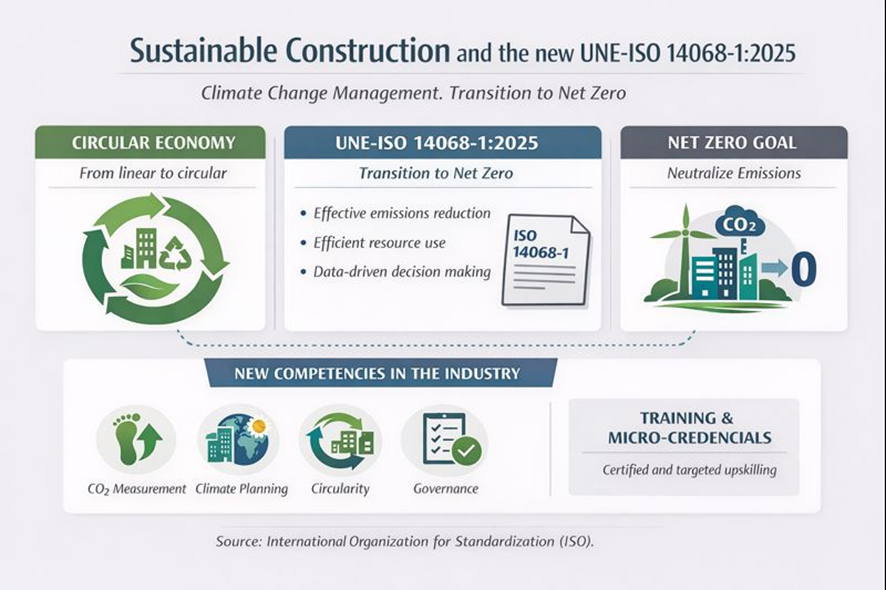
Adopting this approach requires specific competencies that are not typically covered by traditional construction training, such as material traceability, design for reuse, advanced waste management and the integration of climate objectives into decision-making processes. Here, microcredentials play a crucial role by enabling interdisciplinary, practice-oriented and sustainability-focused upskilling, helping circular economy principles become operational realities in construction projects.
In conclusion,the transition towards a more sustainable, resilient and circular construction sector will not be achieved through regulations, technologies or materials alone. It requires a strategic investment in knowledge, specialised skills and lifelong learning.
Modular education based on microcredentials is emerging as one of the most powerful enablers of this transition, allowing organisations and professionals to adapt quickly and effectively to climate, regulatory and technological challenges. In Green Circle project, this kind of learning materials have been development and reflects the project’s objective of supporting the green transition of the construction sector by strengthening sustainability-related skills through flexible and innovative learning approaches, including microcredentials. The analysis presented draws on the project’s work to align policies, sectoral needs and workforce competences in the built environment.
Ultimately, before we can build more sustainable infrastructure for the future, we must build people who are prepared to deliver sustainability today.